


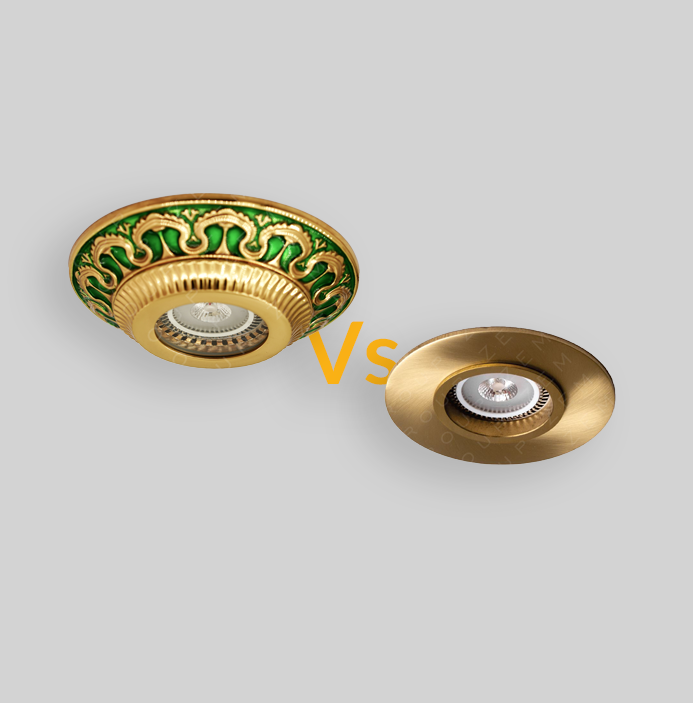
Details That Make a Ceiling Memorable
In modern interior design, no detail is insignificant. Every element, from the largest chandelier to the smallest lighting piece, can shape the character of a space. Among these elements, the downlight holds a special position; a subtle yet effective detail that, when chosen correctly, can transform a ceiling from a plain surface into a highlight of the design.
Downlights not only serve as a protective element for lighting fixtures but also significantly influence the visual beauty of a space. Choosing between classic downlights and modern downlights essentially means choosing between two different design philosophies: one rooted in grandeur and decorative details, and the other based on simplicity, clean lines, and harmony with minimalistic styles.
In this context, the brass material has more impact on the final quality and appearance than anything else. Brass downlights, due to their warm color, durability, and fine finishing capability, are among the most popular options for luxurious and custom spaces. This material is used both in classic downlights with ornate forms and in modern downlights with simple, polished lines, delivering a sense of quality and authenticity in both styles.
Although installing a downlight is usually a straightforward process, using the appropriate hole saw for precise ceiling cuts is important. This tool is only a small part of the installation process, but selecting the correct size ensures the final work remains refined and prevents damage to the ceiling.
Next, we will thoroughly examine the design differences, applications, and visual impact of classic downlights and modern downlights, and explore how brass material can elevate both styles to a higher level of beauty and durability.
Brass Material: A Symbol of Authenticity and Durability in Ceiling Downlights
Among all materials used in lighting fixture construction, brass holds a unique and unrivaled position. Its combination of luxurious appearance, high durability, and excellent finishing capability makes brass downlights a popular choice among interior designers and architects.
Both classic downlights and modern downlights can be made from brass, but the use of this material differs across styles. In classic models, brass is typically finished in warm, golden tones to enhance the sense of authenticity and grandeur. Raised details, carved patterns, or curved edges are all effectively executed thanks to brass’s malleability, resulting in an eye-catching and substantial piece suitable for luxurious, classic, or neoclassical spaces.
In contrast, modern downlights utilize brass differently. Matte or softly polished finishes, or combinations with materials such as steel and aluminum, allow the natural shine of the metal to be more controlled, maintaining a sense of quality and authenticity in the design. In modern downlights, brass is valued not only for its durability but also as a symbol of minimalistic luxury — simplicity that hides elegance and worth within its details.
From a technical perspective, brass is a smart choice. It resists corrosion and discoloration, conducts heat efficiently, and does not deform in humid or warm environments. These properties make it ideal for ceiling installations, especially for recessed lighting, providing safe and long-lasting performance.
Brass downlights also retain their beauty over time. Unlike coated materials, their color and shine do not peel or fade. Although they may develop a slightly darker patina over the years, this subtle change usually adds to their natural charm.
Ultimately, whether you choose a classic downlight or a modern downlight, brass adds value to the space — not only in appearance but also in durability, luxury, and design longevity.
Classic Design in Classic Downlights: Grandeur in Details and Form
The classical style in interior design has long been associated with grandeur, symmetry, and intricate details. Within this framework, the classic downlight continues the same design philosophy. Although this piece may appear small, its impact on the space is significant, combining light, metallic texture, and decorative details.
Classic downlights are typically designed with rounded or oval forms, often featuring decorative borders. Edges may include motifs inspired by European architecture, soft curves, or floral patterns. These delicate details make the downlight more than just a light holder; it becomes a decorative element that complements the ceiling design.
Color plays a vital role in this style as well. Golden, antique bronze, or silver finishes are among the most popular for classic downlights, conveying warmth and authenticity. Paired with yellow or golden-toned light, they create a visually captivating and inviting ambiance.
These downlights are commonly used in spaces like living rooms, dining rooms, luxurious lobbies, hotels, or upscale villas. In these settings, light and decor complement each other, and classic downlights coordinate seamlessly with crystal or brass chandeliers, ceiling moldings, and classic furniture.
Technically, classic downlights are designed to diffuse light softly and focused. Many classic models have deeper edges, which gently spread light around the fixture, creating a warm and cozy environment.
In conclusion, a classic downlight is more than just a lighting fixture — it represents a design philosophy where authenticity, detail, and grandeur are paramount. For spaces designed in neoclassical, royal, or transitional styles, these downlights can elevate visual harmony and elegance.
Modern Design in Modern Downlights: Simplicity in Harmony with Contemporary Spaces
Modern design focuses on simplicity, order, and functionality — principles evident in every part of a space, from furniture forms to lighting choices. Similarly, the modern downlight reflects this philosophy — a design that balances simplicity with high precision and technical sophistication.
Modern downlights avoid complex decorations or raised edges. Design lines are generally straight, angular, and minimal, keeping the viewer’s focus on the light and overall spatial composition. Shapes are often simple circles, squares, or rectangles, with surfaces smooth, matte, or brushed.
Colors typically include matte gold, silver, black, white, and metallic gray, selected to harmonize with architectural elements and maintain a clean, orderly appearance. These downlights are popular in modern homes, offices, galleries, retail spaces, and minimalist projects.
A key aspect of modern downlight design is uniform light distribution and precise beam angles. Unlike classic models that emit warm, focused light, modern downlights provide whiter, wider, and more transparent illumination, making spaces appear brighter, cleaner, and consistent with modern aesthetics.
From a technical perspective, modern downlights are often designed with easier installation, lighter weight, and compatibility with new LED lamps. This reduces energy consumption, enhances durability, and increases lighting safety.
Brass continues to play an important role in modern downlights, but its appearance is more controlled. Matte finishes or combinations with industrial tones help maintain a luxurious feel while fitting seamlessly into minimalist designs.
Ultimately, modern downlights are ideal for those seeking a clean, calm, and harmonious environment — where every element is deliberate, and beauty is found in proportion and precision rather than decorative detail.
Key Differences Between Classic and Modern Downlights
When choosing a downlight for a ceiling, understanding the differences between classic downlights and modern downlights simplifies decision-making. These differences affect not only the visual style but also lighting performance, installation, and spatial harmony.
-
Design and Form
-
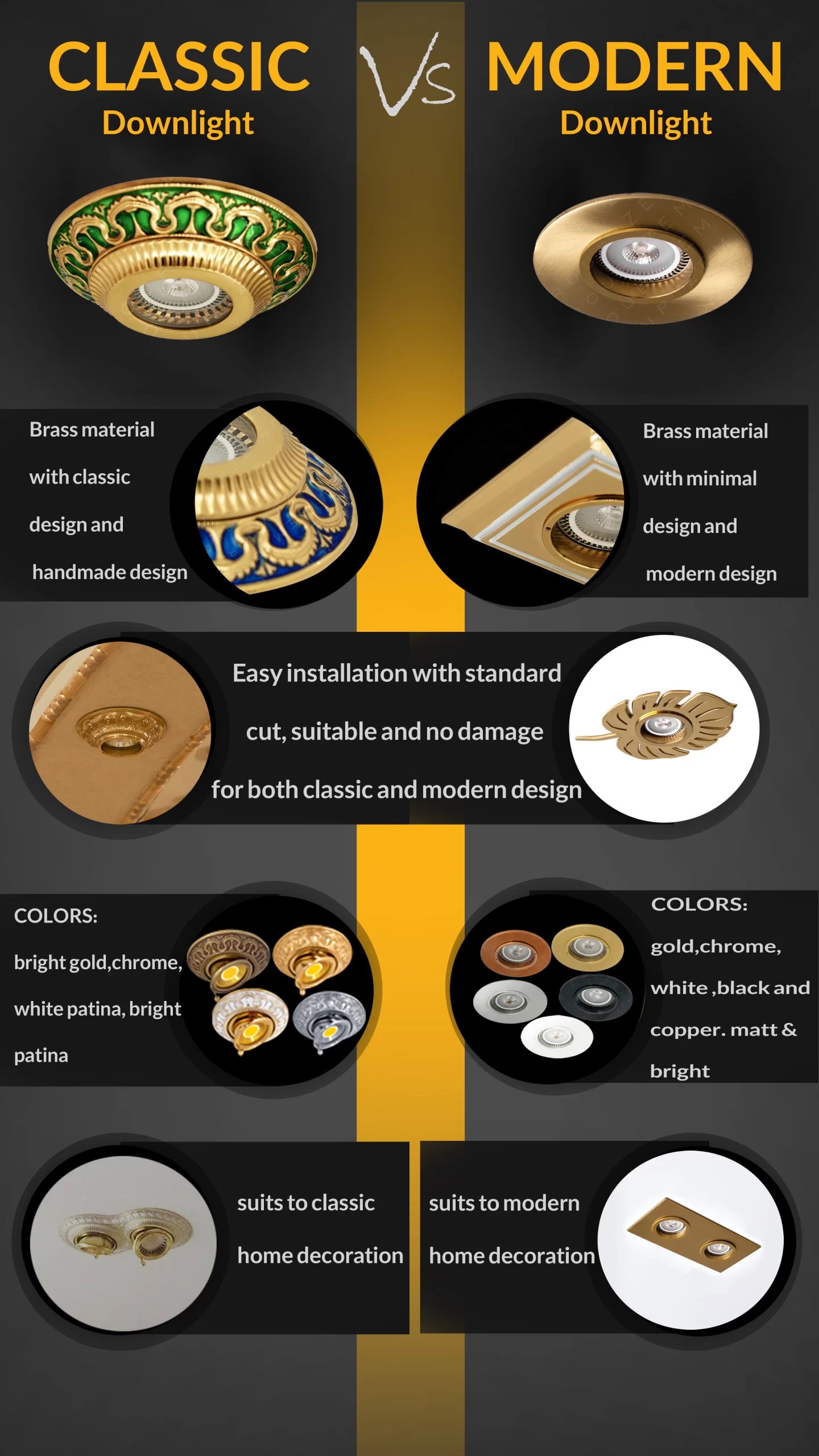
Classic downlight: Features curved lines, raised details, and sometimes decorative patterns, adding a sense of luxury and authenticity.
-
Modern downlight: Simple, flat, and minimal, focusing on harmony with other spatial elements.
-
Lighting Output
-
Classic: Provides warm, focused light, making spaces cozy, inviting, and luxurious. Deep edges help softly diffuse light.
-
Modern: Offers whiter, wider light, producing uniform illumination suitable for minimalist and contemporary spaces.
-
Installation and Spatial Harmony
-
Classic: Suited for grand spaces like living rooms, dining areas, lobbies, or villas, requiring careful coordination with chandeliers, moldings, and furniture.
-
Modern: Appropriate for modern homes, offices, stores, and galleries; lighter and easier to install, compatible with LED systems.
-
Material and Finish
-
Both are made of brass:
-
Classic: Warm, golden, and raised finish conveying luxury.
-
Modern: Matte, brushed, or combined with industrial tones for a controlled, minimal look.
-
-
Practical Note About Hole Saws
Using the correct hole saw is a minor but important step in installation. It ensures precise placement without affecting the lighting or aesthetics of either classic or modern downlights.
The Impact of Lighting Style on Downlight Selection
Lighting is not just about illumination; it shapes the mood and atmosphere. The style of lighting plays a key role in maximizing the aesthetic and functional benefits of classic downlights and modern downlights.
-
Classic downlights: Warm, focused light enhances a cozy and luxurious ambiance, complementing chandeliers and decorative ceilings.
-
Modern downlights: Uniform, clear, and neutral light brightens spaces efficiently, aligning with minimalist and modern interiors.
Matching downlight type to lighting style ensures the space achieves the intended mood and functionality.
Guide to Choosing and Using the Right Hole Saw
While the main focus is on design, lighting, and material, precise installation is essential. A suitable hole saw ensures the downlight fits neatly, preserving ceiling integrity. Key points:
-
Accuracy: Correct size ensures the downlight sits flush without gaps or pressure.
-
Preserving aesthetics: Prevents rough edges or damage.
-
Ease of installation: Speeds up work and prevents fixture or ceiling damage.
For classic downlights, a larger, high-quality hole saw is recommended due to greater depth and diameter. For modern downlights, a medium-sized hole saw is sufficient, but alignment accuracy is critical. Safety measures, proper drill speed, and precise marking are essential.
Frequently Asked Questions (FAQ)
-
What is the main difference between classic and modern downlights?
-
Classic: Ornate, curved lines, warm light, suited for luxurious and traditional spaces.
-
Modern: Minimal, uniform light, ideal for modern and minimalist spaces.
-
Can both types be made from brass?
-
Yes, brass provides durability, corrosion resistance, and a luxurious look.
-
How does lighting style affect downlight choice?
-
Warm, cozy lighting suits classic downlights.
-
Uniform, bright lighting suits modern downlights.
-
Is installing downlights difficult?
-
Installation is simple for both types, but accuracy is important. Using the correct hole saw ensures proper placement and safety.
-
Which spaces suit each type?
-
Classic: Living rooms, dining areas, lobbies, upscale villas.
-
Modern: Modern homes, offices, stores, galleries, minimalist spaces.
-
Do brass downlights require special maintenance?
-
Brass is highly durable and easy to maintain with a soft dry cloth or metal polish to preserve shine.

