

OSCILLOGRAPHIC
HALOGEN LAMP FUJI JS
The history of the oscilloscope goes back to the first recordings of waveform with a galvanometer connected to a mechanical tension system in the second decade of the 19th century.
The oscilloscope was invented by the French Engineer and physicist André Blundel, who built and presented the first electromechanical oscilloscope in 1893.
This device was able to record the values of electrical quantities such as the intensity of alternating current. An oscilloscope allows you to view how voltage changes over time.
An ink pendulum attached to a coil recorded this information on a moving paper tape. The first oscilloscopes used several mechanical devices in their work process, which made their measurements not very accurate and their bandwidth was very low, between 10 and 19 kHz. A major step in the development of oscilloscopes was taken in 1897, when a German physicist, Carl Ferdinand Braun, invented a cathode ray tube (CRT). An English company named A. C. Cossor, which was the first company in the world to adopt this technology, presented its first oscilloscope in 1932.
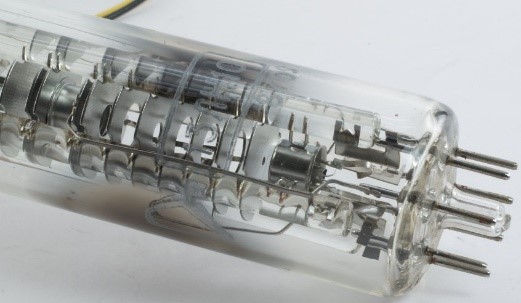
CRT module is a special vacuum tube that contains an electron gun, a set of horizontal and vertical deflection plates, several electronic lenses and a display, covered with layers of fluorescent and phosphorescent coating on the inner side.
Product model:
Huge USSR Pulse Modulator Thyratrone TGI1-700/25 Tesla Coil
Country of manufacture: Russia.
Price: $140
Application:
Thyratron pulse modulator TGI1-700 / 25 is intended for switching in the linear modulator circuit.
|
Name |
Thyratrone |
|
Model |
TGI1-700/25 |
|
Brand |
Polaron |
|
Filament voltage |
6.3 V |
|
Heating current |
17 – 23 A |
Parameters of ignition grid pulse:
voltage amplitude | 70—2000 V |
pulse duration at 300 V | 3 – 6 μs |
the steepness of the pulse front | 1000-2000 V / μs |
amplitude of grid current | 3 – 8 A |
Technical Information:
Special plinth | 4-pin |
Envelope | glass |
Warm-up time | 7 min |
A-C voltage, | 18 V |
Ambient temperature | -60 to + 90 ° C |
Service life | not less than 400 hours |
Weight | no more than 2,5 kg |
The amplitude of direct voltage at the anode | 12KV |
The current in the anode circuit | In the 700A pulse |
Output power in impulse | 8700 KW |
The average value of the current in the anode circuit | 1 A |
The average output power | 12.5 kW |
Voltage on the grid | not less than 700 V |
The current in the grid circuit | 3 – 8 V |
Pulse frequency | 500 imp / s |
Pulse width | 2.8 μs |
periodic ignition instability | not more than 0,03 μs |
Voltage drop on the thyratron in a pulse | no more than 200 V |
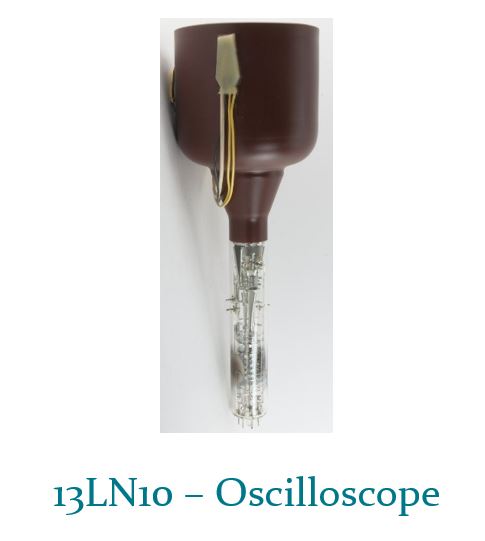
Voltage on the anodes 13LN10:
on the 1st anode | from 730 V to 800 V |
on the 2nd anode | from -100 V to +100 V |
UMish | from -2 V to 15 V |
USenior reseracher | not more than 25 V |
Uand | from 4 kV to 4.5 kV |
Sensitivity:
– Temporary deflection plates – from 0.4 mm/V to 0.5 mm/V;
– Signal deflection plates – from 0.7 mm/V to 0.8 mm/V.
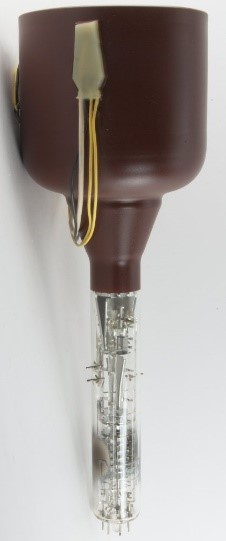
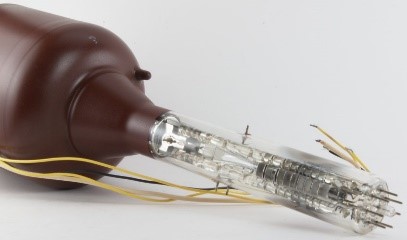
Image brightness is at least 1 cd/m2. The design is glass baseless with additional terminals on the cylinder. Durability of at least 500 hours. The screen glow color is yellow green. The recording speed is not less than 4000 m/s. Information storage time – at least 24 hours. The playback time of the 13LN10 image is not less than 60 s.
Dimension
365 x 132 x 54 mm.
Weight 1 kg.
Links:
https://www.thomann.de/gb/tungsram_cp29_g38_5000w.htm
https://mik.tv/en/halogen-lamps/lamp-koto-cp29/
https://www.prolampsales.com/products/koto-cp29-220v-230v-dpy-5000w-220v-halogen

